June 23, 2026

Trusting the aviation data in the box: What you need to know

How aeronautical data is processed, verified, and delivered to your flight deck — more than 500,000 times a year

Accurate aeronautical data and navigation database integrity are foundational to safe flight operations. Every time a pilot enters a flight plan, selects a route, or diverts to an alternate airport, the reliability of that action depends entirely on the quality of the navigation data loaded in the avionics. When fuel is low and weather is closing in, the data in that Flight Management System (FMS) box is not a background detail — it is a critical operational asset. Understanding how aeronautical data is sourced, processed, and delivered helps flight crews and aviation professionals trust what they see on the flight deck.

Aviation data source providers

First, there are the source providers. These are all the civil and defense aeronautical authorities from around the world such as the Federal Aviation Administration (FAA) in the U.S. or European Union Aviation Safety Agency (EASA) in Europe. There are246 in total from 195 nations. Why are there more providers than nations? Because in some nations there are multiple agencies. For example, in the United States the FAA and the Department of Defense provide source data across the civil and military domains.

Aviation data processors

Second, there are data processors who take the raw source information and produce a formatted database file compliant with industry standards. Jeppesen is one company that has pioneered the navigation data production process over the last 50 years.

Aviation data OEM packers

Lastly, the avionics manufacturer, or Original Equipment Manufacturer (OEM), will take the standardized data and re-format it again into a binary file (called packing the data) for use in their proprietary software and avionics equipment. While data processors is a term that describes the function of converting  raw source data into a formatted data set, it is a rather simplistic term that deserves some context. The resources, personnel, and tools required to process and produce formatted navigation data for a specific regional area demand a significant and monumental effort. But at a global level, it takes an entire village with decades of experience to process and maintain a database that contains over two million data records.

At Jeppesen, nearly 30% of the workforce, or almost 1,000 employees, are dedicated to global data management and support.

How aviation data is processed

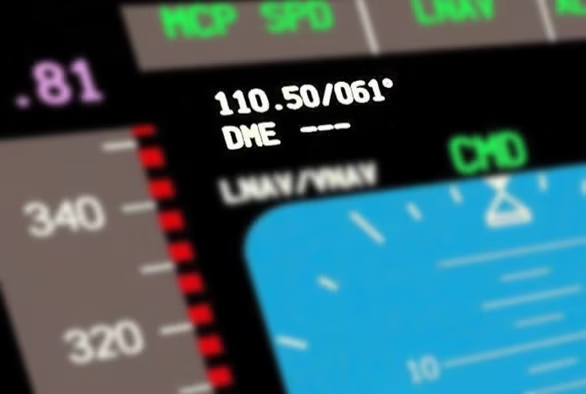
The path from raw state-published source data to a verified avionics database file involves four distinct production phases. The following walkthrough illustrates that process using a practical example:  a revised localizer frequency that’s being changed to 110.50 MHz as a result of newly installed airport equipment.

The four phases in the data production process:

  1. Acquire
  2. Review
  3. Maintain
  4. Distribute

Behind this four-step framework stands  an entire village of specialists whose singular objective is accuracy — ensuring the largest and most trusted aeronautical database is available on your flight deck when it matters most.

1. Acquire the source data

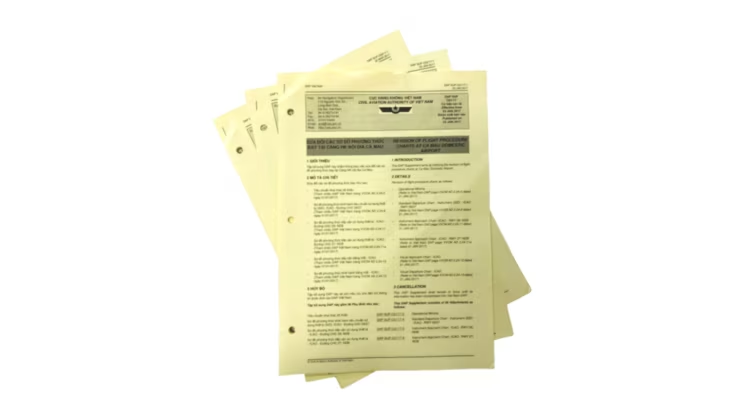
All new source data, whether it’s new or a revision to existing data, begins by being published in official state documentation in a variety of formats that are ultimately compiled into the Aeronautical Information Publication (AIP). The first step is acquisition. This is accomplished through  source subscriptions and reaching out to aeronautical authorities around the world.

There are 246 data source providers from 195 countries providing 47,000 pieces of data in 24 different languages every 28 days.

Source data comes in many different formats.

That volume — 246 global providers, 47,000 data submissions per cycle, written in 24 languages, and no standardized format — represents a monumental intake challenge. The standard AIRAC update cycle repeats every 28 days, generating  typically to the tune of approximately 47,000 pieces of source every month, or more than 500,000 pieces annually.

When discrepancies arise, response time is critical. A healthy relationship with source providers and clear channels of communication is vital. This critical role is typically held by a team of experienced source liaisons with long-standing relationships across global aeronautical authorities.

2. Review the data

The source data undergoes  a rigorous review and verification process before it advances through the production pipeline. . Each data element is evaluated  not just once, but many times before it completes the process.

Once the new data is loaded into a source repository it’s then reviewed to make sure it’s valid or “fit for use”. This means the source documents are evaluated for completeness – if the source provider stated there are 100 pages for a particular update cycle but only 95 pages were received, that discrepancy must be resolved before processing continues.  Legibility and visual integrity are also confirmed for any scanned documentation.  With so many source documents received in different formats and languages, this is a crucial step in the process.


Data specialists apply over 10,000 business rules when reviewing source data.

3. Maintain the data

After the source data is acquired and reviewed, the data revision is ready for the next phase where it will be added to the master aviation database. This is called the data maintenance phase. The first step the data maintenance team takes is, another in-depth review of the source changes.

A review is done to compare the new source data against the previous source data. This ensures all changes are captured with every new source publication. The source information for our example localizer frequency change may contain other changes such as location coordinates or a new bearing direction. It all must be captured, reviewed and processed.

A sanity check is also applied at this stage. Consider a scenario where the revised localizer frequency appears in source documentation as 101.50 MHz — an FM broadcast frequency, not a valid navaid frequency. It would most likely be a typo made by the source originator that should have listed it as 110.50 MHz. This is called a source anomaly, and it must be resolved with the source provider.

This doesn’t happen that often, right?

Actually, source anomalies happen about 2,500 times every year. That’s almost 200 source anomalies to resolve every 28-day cycle.

Data experts translate, analyze, validate and verify source data.


Data specialists also review the new change to determine how it will impact other components in the database. A single frequency update can affect airport records, terminal procedure records, and enroute records simultaneously . All database records linked to that frequency must be checked and verified.

Finally, the new data is added or ‘coded’ into the master database.  The process does not end there. Edits are reviewed and any errors are corrected with the new data entries. This step is performed with workflow tools and a huge library of Quality Check (QC) business rules. Jeppesen has over 10,000 business rules as part of the QC process.

As a final verification step for highly-critical data, an independent data specialist re-enters the information from the original source document — not as a cross-check or visual comparison, but as an independent replication of the original data entry action. This dual-entry method is one of the most effective safeguards against data entry errors in the production process.

Once committed to the master aviation database, the data maintenance team prepares for the next cycle — a process that repeats every 28 days, without exception.

4. Distribute the data

In the final phase,  over 2 million aeronautical data records are extracted and distributed globally. . This happens every 28 days per the regulatory Aeronautical Information Regulation and Control (AIRAC) cycle calendar. Depending on the year, there are typically 13 AIRAC cycle updates annually.

The process starts with a snapshot of the master database that is taken and run through additional QC evaluations to resolve any errors before it’s formatted to the final ARINC-424 standard (Aeronautical Radio INC). This international standard is defined by the International Civil Aviation Organization (ICAO), headquartered in Montreal, Canada. This single standardized format consolidates contributions from hundreds of global providers into one coherent, industry-compliant data set.

Each avionics OEM further requires the data to be formatted for their proprietary systems. This is called packing the data and it can be performed by data providers such as Jeppesen (in agreement with some OEMs), by the OEM itself, or by a third-party data packing company. The data packing process takes into consideration avionics and aircraft specific requirements which allow the ARINC 424 data to be packaged in a way that supports the aircraft mission needs.  Once the data is packed, then it is finally distributed to end users and loaded into the avionics panel, typically a Flight Management System box, Multi-Function Display or other devices such as Electronic Flight Bags (EFB).

There are several companies that provide database products in different regions of the world. Jeppesen stands out as the leader with over 50-years of producing the largest and most accurate global data products. In fact, the first ever FMS database was created by Jeppesen in 1973 through an effort led by a former employee, Jim Terpstra.That foundational work, initiated by former Jeppesen employee Jim Terpstra, established the company as the global standard in aeronautical navigation.

Check out this video about the beginning of Jeppesen NavData.

 

New frequency appears on the primary flight display.

It really does take a village

That localizer frequency change to 110.50 MHz — one data point among millions — required the coordinated effort of nearly 1,000 professionals to reach the flight deck accurately and on time. The finished database product has earned the stamp of quality by all those people who helped make it possible so you can trust the data in the box.