

What is cost index optimization?
Cost index optimization is the practice of using a flight’s cost index—the ratio of time-related costs to fuel costs—to balance fuel burn against time-based operating expenses and set the most efficient speed profile. The “optimization” comes from replacing generalized, factory-based assumptions with accurate, aircraft-specific performance data, so each airframe receives a cost index recommendation that reflects how it actually flies today. The result is a speed profile tuned to real-world conditions, helping airlines cut fuel costs and emissions without sacrificing schedule reliability.
The problem: OEM Performance Data quietly drains profitability
In the current aviation environment, balancing fuel costs and operational efficiency is a primary directive for airlines. Fossil-based jet fuel remains the largest cost component of airline operations, representing approximately 30% of total industry costs globally. With average fuel costs seeing significant increases and persistent market volatility, precise fuel management is essential.
Traditionally, flight crews have relied on a static Cost Index (CI) derived from OEM factory flight test data. This is where margin slips away. Static values assume every airframe performs like a factory-fresh model, but no aircraft does. As airframes age, drag and engine wear push real performance away from the book, so crews fly at speeds that are no longer optimal—burning more fuel or losing time on nearly every sector.
The opportunity: move from static to dynamic, tail-specific CI
Airlines that shift from static assumptions to dynamic, tail-specific CI can reclaim meaningful savings on every flight. This capability accounts for actual aircraft degradation and real-world fuel consumption, providing flight crews with accurate performance parameters. By identifying the true efficiency point of each specific aircraft, you can save up to 2% in fuel consumption while simultaneously optimizing flight time.
That 2% is not theoretical. The proof below shows what a real operator achieved—then we explain exactly how the capability works.
The economics of flight: understanding cost index
The Cost Index model optimizes Direct Operating Costs (DOC) by balancing fuel consumption against time-related expenses. Direct operating costs for a flight fall into three primary categories:
- Fuel costs: the financial expense of the fuel burned during the flight.
- Fixed costs: charges that do not vary with flight time, including landing and navigation fees.
- Time-related costs: expenses that increase with flight duration, such as portions of crew salaries and specific maintenance elements.
The Cost Index targets the balance between fuel and time-related costs, directing the ECON function in the Flight Management Computer (FMC) to set optimal flight speeds. The CI quantifies the relative importance of time versus fuel. The CI is entered into the FMC and is calculated as:
Imperial units: CI = Time Cost ($/hr) ÷ Fuel Cost (¢/lb)
Metric units: CI = Time Cost ($/min) ÷ Fuel Cost ($/kg)
A higher CI increases flight speed, resulting in shorter trip times but higher fuel use. A lower CI decreases flight speed, conserving fuel while extending flight duration. A CI equal to zero achieves maximum fuel efficiency (minimum fuel speed). A very high CI maximizes speed, by sacrificing fuel efficiency to save time.
While this formula balances costs in theory, traditional calculations rely on legacy assumptions. As aircraft age, performance deviates from original factory specifications due to increased drag and engine wear. Relying on static book values often results in flying at suboptimal speeds. Airlines have historically made fuel and speed decisions based on these static assumptions rather than dynamic, aircraft-specific data.
The solution: dynamic CI with Jeppesen FliteDeck Pro
We provide a more advanced approach. By integrating tail-specific, real-world performance data, Jeppesen FliteDeck Pro delivers exact CI recommendations, driving significant fuel savings and reducing carbon emissions.
The surprising result: flying faster to save fuel
A notable benefit of dynamic Cost Index Optimization is the frequent discovery that an aircraft’s true minimum fuel speed (MINFUEL) is faster than indicated by standard performance charts. Because FliteDeck Pro analyzes the actual performance data of the specific airframe, it often recommends speeds slightly higher than book values.
For example, real performance curves frequently show a MINFUEL speed at a higher CI than the manufacturer’s charts suggest. By increasing the speed to match this real-world performance, the aircraft achieves better fuel efficiency.
By flying at this optimized MINFUEL speed, you can reduce fuel consumption while arriving at your destination a few minutes earlier. Over an entire fleet, this reduction in flight time significantly decreases time-based maintenance costs, such as engine wear, contributing to broader operational efficiency.
Effortless flight efficiency with FliteDeck Pro
Fuel savings programs are only as effective as the adoption you can drive. Theoretical savings mean nothing if pilots do not follow through. Jeppesen’s Cost Index Optimization integrates directly into your existing pilot EFB workflow within FliteDeck Pro. It is not a separate app that reduces pilots’ situational awareness. It requires no additional hardware or secondary Electronic Flight Bag (EFB) applications. Most importantly, it is easy to use: pilots only need to enter three parameters: Weight, Temperature and Flight Level.
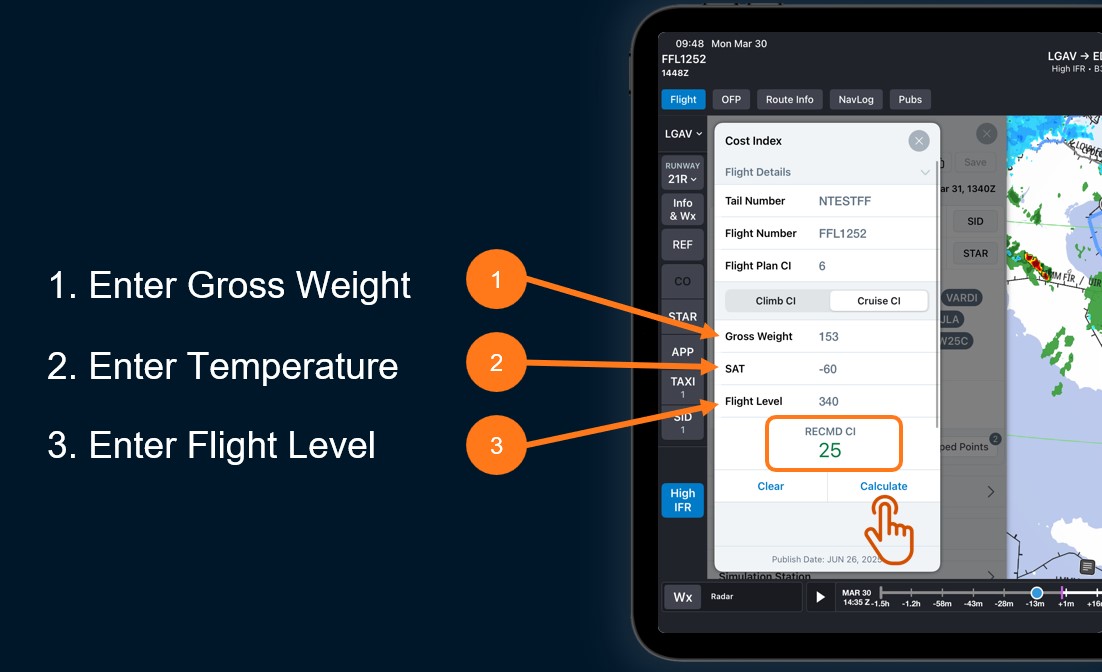
These CI parameters can be retrieved directly from Aircraft Interface Devices (AIDs) that support protocols like: JeppStd, Teledyne, and Collins ADBP. This means the recommended CI can be calculated automatically.
Dual phase optimization: climb and cruise
To maximize efficiency throughout the flight profile, FliteDeck Pro now provides two separate cost index values to optimize: Climb CI* and Cruise CI. We have structured these optimizations into distinct tabs within the application to minimize pilot workload and facilitate ease of use during the enroute phase of flight.
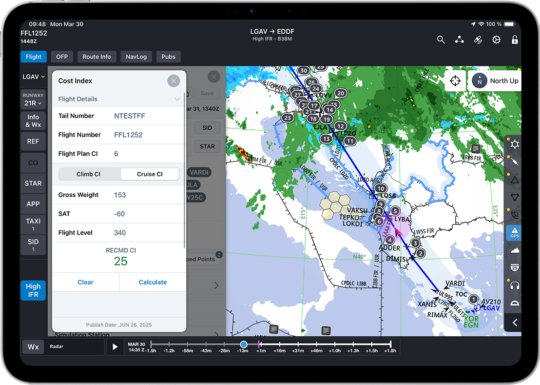
Providing distinct indices for these two critical phases ensures your aircraft operates at peak efficiency from ascent through the enroute segment.
Proven real-world impact
Airlines utilizing dynamic Cost Index Optimization have recorded measurable improvements in both cost reduction and environmental sustainability.
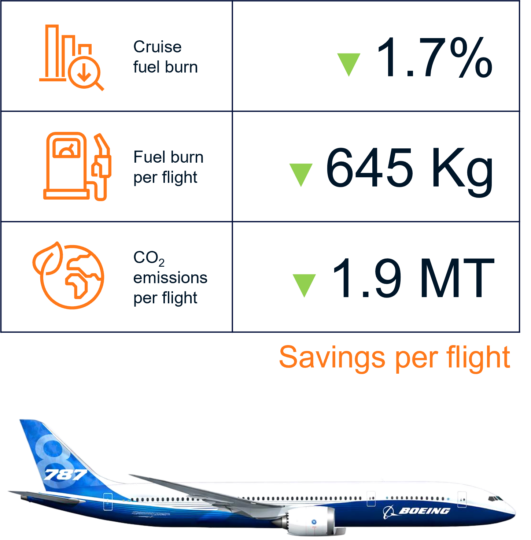
By adjusting their CI with Jeppesen CIO, a UK-based airline achieved a 1.7% reduction in fuel consumption. This equates to reducing emissions by 1,900 kg per flight, demonstrating that precise, data-driven adjustments deliver substantial environmental and financial benefits.
A four-step path to fuel savings
Integrating this capability into your operations for aircraft running FliteDeck Pro 5.0 or later is a straightforward process:
- Data provisioning: supply historical flight data, such as Quick Access Recorder (QAR) or Flight Data Recorder (FDR) information, via a secure transfer.
- Tail-specific performance calibration: we generate highly accurate performance curves for each individual aircraft in your fleet based on its tail number.
- Capability activation: our team activates the feature across all devices associated with the subscribed aircraft. Pilots gain immediate access to the necessary input fields directly within the FliteDeck Pro app.
- Savings monitoring: we help you track fuel usage closely before and after activation, providing detailed reports so you can measure precise fuel savings over time.
Enhance your mission success
Your sustainability mandates and financial targets demand precise, data-driven decisions. Cost Index Optimization in FliteDeck Pro gives your flight crews the authoritative, tail-specific performance data they need to cut fuel burn and lower operating costs. Contact us to start your four-step path to measurable savings.
* Climb CI is only for supported aircraft types
→ READ NEXT: Capabilities Guide for Cost Index Optimization in Jeppesen FliteDeck Pro
Cost index optimization is the practice of using a flight’s cost index—the ratio of time-related costs to fuel costs—to balance fuel burn against time-based operating expenses and set the most efficient speed profile. The “optimization” comes from replacing generalized, factory-based assumptions with accurate, aircraft-specific performance data, so each airframe receives a cost index recommendation that reflects how it actually flies today. The result is a speed profile tuned to real-world conditions, helping airlines cut fuel costs and emissions without sacrificing schedule reliability.
The problem: OEM Performance Data quietly drains profitability
In the current aviation environment, balancing fuel costs and operational efficiency is a primary directive for airlines. Fossil-based jet fuel remains the largest cost component of airline operations, representing approximately 30% of total industry costs globally. With average fuel costs seeing significant increases and persistent market volatility, precise fuel management is essential.
Traditionally, flight crews have relied on a static Cost Index (CI) derived from OEM factory flight test data. This is where margin slips away. Static values assume every airframe performs like a factory-fresh model, but no aircraft does. As airframes age, drag and engine wear push real performance away from the book, so crews fly at speeds that are no longer optimal—burning more fuel or losing time on nearly every sector.
The opportunity: move from static to dynamic, tail-specific CI
Airlines that shift from static assumptions to dynamic, tail-specific CI can reclaim meaningful savings on every flight. This capability accounts for actual aircraft degradation and real-world fuel consumption, providing flight crews with accurate performance parameters. By identifying the true efficiency point of each specific aircraft, you can save up to 2% in fuel consumption while simultaneously optimizing flight time.
That 2% is not theoretical. The proof below shows what a real operator achieved—then we explain exactly how the capability works.
The economics of flight: understanding cost index
The Cost Index model optimizes Direct Operating Costs (DOC) by balancing fuel consumption against time-related expenses. Direct operating costs for a flight fall into three primary categories:
- Fuel costs: the financial expense of the fuel burned during the flight.
- Fixed costs: charges that do not vary with flight time, including landing and navigation fees.
- Time-related costs: expenses that increase with flight duration, such as portions of crew salaries and specific maintenance elements.
The Cost Index targets the balance between fuel and time-related costs, directing the ECON function in the Flight Management Computer (FMC) to set optimal flight speeds. The CI quantifies the relative importance of time versus fuel. The CI is entered into the FMC and is calculated as:
Imperial units: CI = Time Cost ($/hr) ÷ Fuel Cost (¢/lb)
Metric units: CI = Time Cost ($/min) ÷ Fuel Cost ($/kg)
A higher CI increases flight speed, resulting in shorter trip times but higher fuel use. A lower CI decreases flight speed, conserving fuel while extending flight duration. A CI equal to zero achieves maximum fuel efficiency (minimum fuel speed). A very high CI maximizes speed, by sacrificing fuel efficiency to save time.
While this formula balances costs in theory, traditional calculations rely on legacy assumptions. As aircraft age, performance deviates from original factory specifications due to increased drag and engine wear. Relying on static book values often results in flying at suboptimal speeds. Airlines have historically made fuel and speed decisions based on these static assumptions rather than dynamic, aircraft-specific data.
The solution: dynamic CI with Jeppesen FliteDeck Pro
We provide a more advanced approach. By integrating tail-specific, real-world performance data, Jeppesen FliteDeck Pro delivers exact CI recommendations, driving significant fuel savings and reducing carbon emissions.
The surprising result: flying faster to save fuel
A notable benefit of dynamic Cost Index Optimization is the frequent discovery that an aircraft’s true minimum fuel speed (MINFUEL) is faster than indicated by standard performance charts. Because FliteDeck Pro analyzes the actual performance data of the specific airframe, it often recommends speeds slightly higher than book values.
For example, real performance curves frequently show a MINFUEL speed at a higher CI than the manufacturer’s charts suggest. By increasing the speed to match this real-world performance, the aircraft achieves better fuel efficiency.
By flying at this optimized MINFUEL speed, you can reduce fuel consumption while arriving at your destination a few minutes earlier. Over an entire fleet, this reduction in flight time significantly decreases time-based maintenance costs, such as engine wear, contributing to broader operational efficiency.
Effortless flight efficiency with FliteDeck Pro
Fuel savings programs are only as effective as the adoption you can drive. Theoretical savings mean nothing if pilots do not follow through. Jeppesen’s Cost Index Optimization integrates directly into your existing pilot EFB workflow within FliteDeck Pro. It is not a separate app that reduces pilots’ situational awareness. It requires no additional hardware or secondary Electronic Flight Bag (EFB) applications. Most importantly, it is easy to use: pilots only need to enter three parameters: Weight, Temperature and Flight Level.
These CI parameters can be retrieved directly from Aircraft Interface Devices (AIDs) that support protocols like: JeppStd, Teledyne, and Collins ADBP. This means the recommended CI can be calculated automatically.
Dual phase optimization: climb and cruise
To maximize efficiency throughout the flight profile, FliteDeck Pro now provides two separate cost index values to optimize: Climb CI* and Cruise CI. We have structured these optimizations into distinct tabs within the application to minimize pilot workload and facilitate ease of use during the enroute phase of flight.
Providing distinct indices for these two critical phases ensures your aircraft operates at peak efficiency from ascent through the enroute segment.
Proven real-world impact
Airlines utilizing dynamic Cost Index Optimization have recorded measurable improvements in both cost reduction and environmental sustainability.
By adjusting their CI with Jeppesen CIO, a UK-based airline achieved a 1.7% reduction in fuel consumption. This equates to reducing emissions by 1,900 kg per flight, demonstrating that precise, data-driven adjustments deliver substantial environmental and financial benefits.
A four-step path to fuel savings
Integrating this capability into your operations for aircraft running FliteDeck Pro 5.0 or later is a straightforward process:
- Data provisioning: supply historical flight data, such as Quick Access Recorder (QAR) or Flight Data Recorder (FDR) information, via a secure transfer.
- Tail-specific performance calibration: we generate highly accurate performance curves for each individual aircraft in your fleet based on its tail number.
- Capability activation: our team activates the feature across all devices associated with the subscribed aircraft. Pilots gain immediate access to the necessary input fields directly within the FliteDeck Pro app.
- Savings monitoring: we help you track fuel usage closely before and after activation, providing detailed reports so you can measure precise fuel savings over time.
Enhance your mission success
Your sustainability mandates and financial targets demand precise, data-driven decisions. Cost Index Optimization in FliteDeck Pro gives your flight crews the authoritative, tail-specific performance data they need to cut fuel burn and lower operating costs. Contact us to start your four-step path to measurable savings.
* Climb CI is only for supported aircraft types
→ READ NEXT: Capabilities Guide for Cost Index Optimization in Jeppesen FliteDeck Pro