Five ways an integrated EFB improves pilot operations
Commercial aviation has undergone major digital transformation since the introduction of the Electronic Flight Bag (EFB) in the 2010s. What began as a means to replace cumbersome paper charts over a decade ago has since evolved into fragmented flight operations consisting of both digitized and paper-based processes.
While commercial carriers globally continue working towards fully digital operations, many of these systemic issues culminate in challenges that impact pilot operations as a result of disparate applications, siloed data and systems, and paper-dependent workflows.
However, the modern EFB has since evolved into an integrated EFB, which works to centralize EFB applications, workflows, and data into a single source for pilots and flight operations teams as a whole.
In this article, we focus on the flight deck and five ways an integrated EFB improves pilot performance.
1. Digitize flight briefing packages
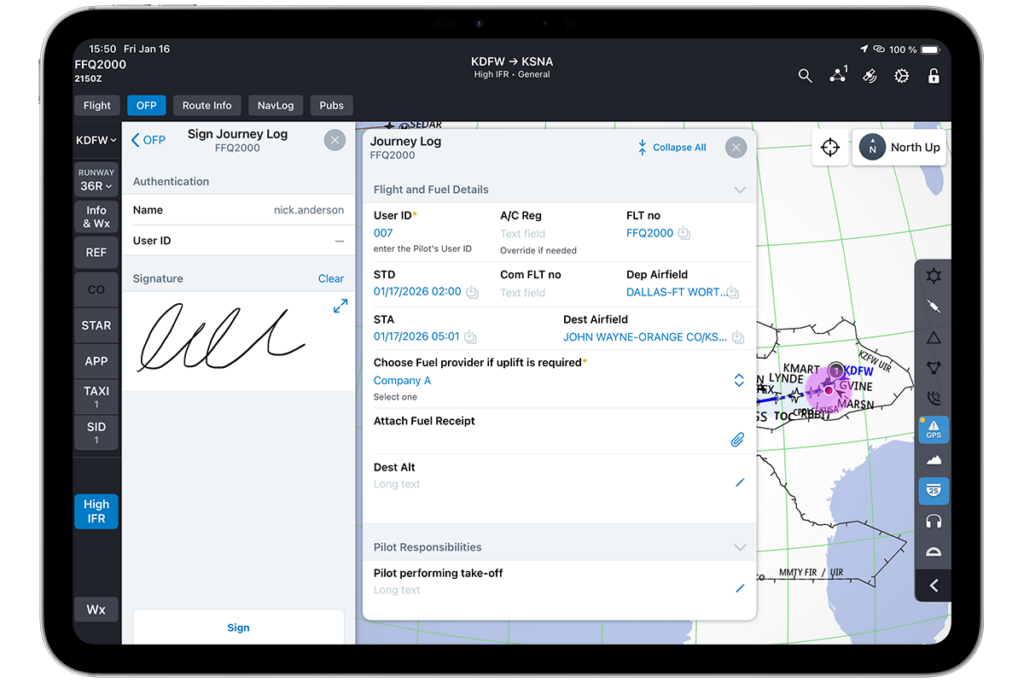
With an integrated EFB, pilots can complete forms and any related signatures for flight within their EFB. Jeppesen’s integrated Briefing Module allows pilots to do just that without leaving the FliteDeck Pro app.
Traditional paper-based flight briefings are resource-intensive and prone to inefficiencies, such as added costs, outdated information and accessibility challenges. By digitizing briefing packages into an integrated EFB, pilots can access critical flight data directly from their devices, eliminating the need to switch between applications or paperwork.
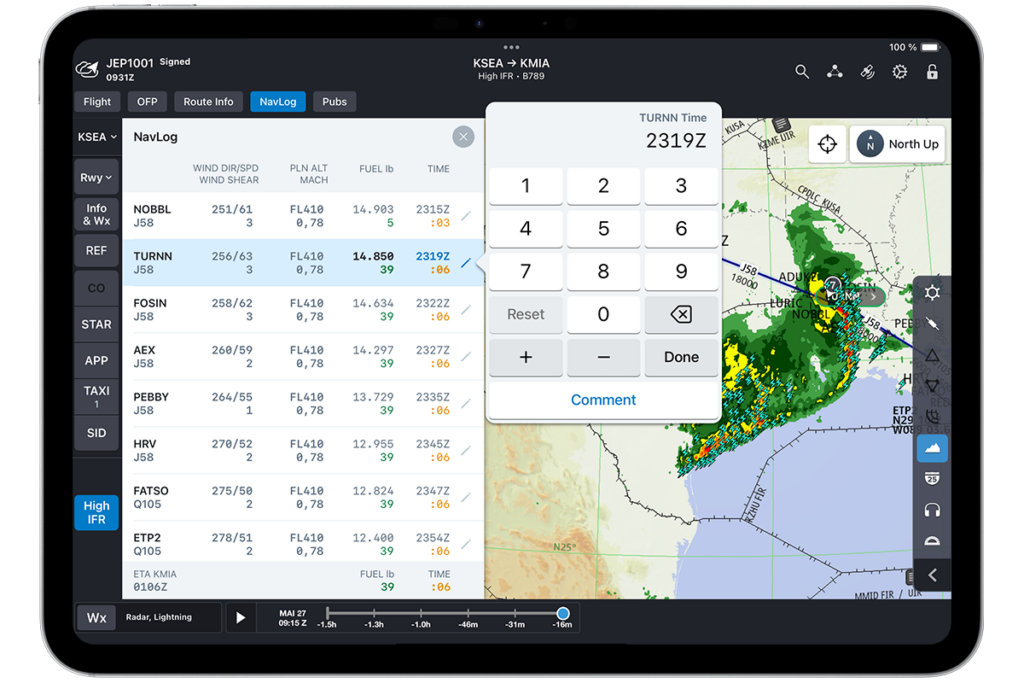
Jeppesen FliteDeck Pro integrates Operational Flight Plans (OFP) and an interactive Digital NavLog—providing pilots with a streamlined and fully synchronized navigation workflow.
Key benefits:
For pilots: Access all flight data in one place, reducing cognitive load and distractions. Pilots can also log actuals, such as fuel consumption and flight time, using the integrated Digital NavLog.
For back office: Real-time access to post-flight data to support rapid analysis and decision-making.
For airlines: Reduce operational costs by replacing physical documentation with a digital alternative.
Making the shift to digital, integrated flight briefings not only saves flight ops teams time, but it ensures that pilots have the most up-to-date information available during flight preparation and execution.
The digital NavLog in Jeppesen’s Briefing Module is integrated with FliteDeck Pro, allowing pilots to keep real-time tracking of waypoints, fuel, time, and performance without leaving their enroute map.
Navigation logging is an essential pilot workflow that ensures flight data accuracy and compliance. Traditionally reliant on manual inputs and physical log sheets, this process is prone to human error, inefficiency and delays in recording actuals like times and fuel values.
With FliteDeck Pro, pilots can interact with a Digital NavLog that automatically synchronizes with the in-app flight route. If the route changes mid-flight, the Digital NavLog updates in real time, ensuring a seamless flow of information.
Pilot advantages:
Record actual time and fuel values for waypoints in the navigation map, reducing errors
A fully integrated view of navigation logs within existing workflows
Enhanced situational awareness and responsiveness to time and fuel trends
By digitizing navigation logging, airlines gain accurate data for post-flight analytics while pilots can trust their tools to deliver precise, actionable information.
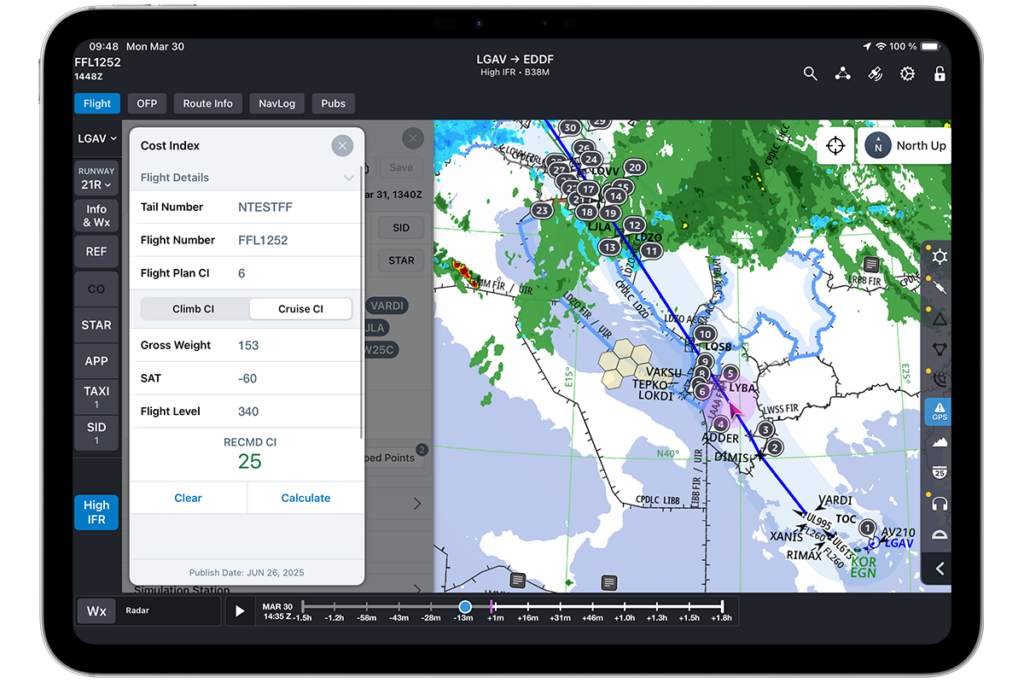
No app switching, just fuel savings. Cost Index Optimization integrates directly with FliteDeck Pro, so pilots receive in-flight fuel advisories within their EFB.
Fuel consumption represents one of the highest operating costs for airlines, often comprising 30–40% of total expenses. Utilizing fuel optimization advisories within an EFB can drastically reduce fuel consumption, improving sustainability and cost-efficiency.
Jeppesen’s Cost Index Optimization tool integrates natively with FliteDeck Pro to provide tail-specific, in-flight fuel advisories. Pilots simply input three variables—weight, temperature and altitude—and the system produces a recommended Cost Index (CI) calculation for optimal fuel efficiency.
For airlines utilizing a supported AID (Aircraft Interface Device), this is fully automated with FliteDeck Pro version 5.2. Cost Index Optimization automatically pulls the necessary data points from the AID, eliminating the need for pilots to enter any information, making reduced fuel burn fully automated and integrated.
Impactful results:
Achieve 1.5–2% cruise fuel savings per flight without extra hardware or connectivity
Support corporate sustainability goals by cutting carbon emissions
Maximize fleet efficiency while maintaining or improving on-time performance
This level of in-flight precision puts the power of fuel optimization directly in the hands of pilots, a critical factor in improving operational performance and reducing variable costs.
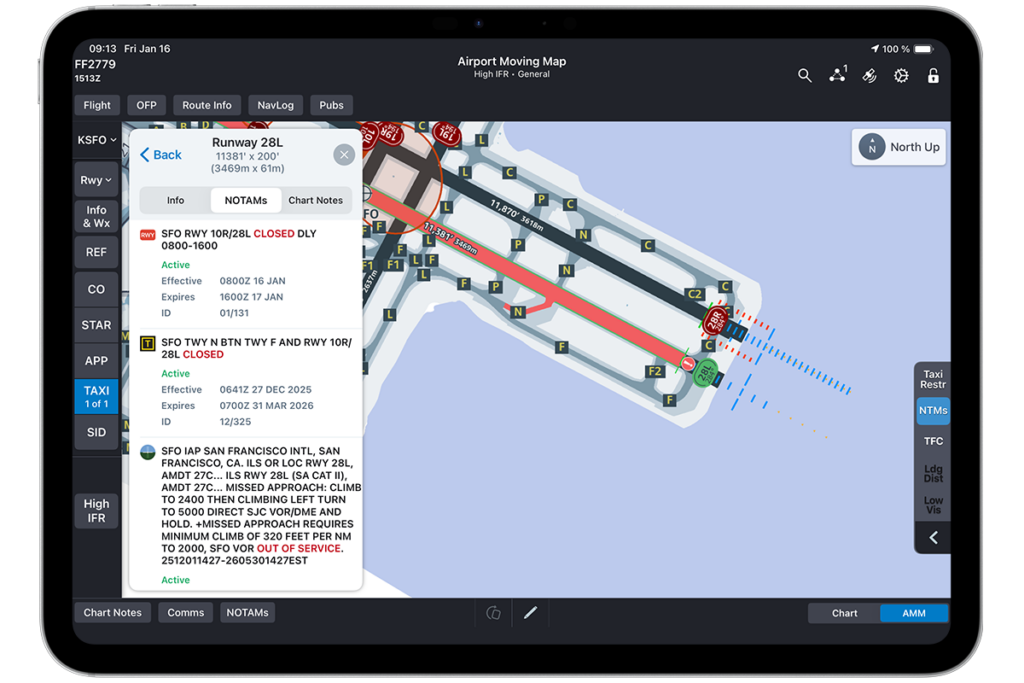
Graphical NOTAM depicting a closed taxiway at SFO with Smart Airport Maps in FliteDeck Pro allows pilots to visualize critical information within their EFB on their airport map.
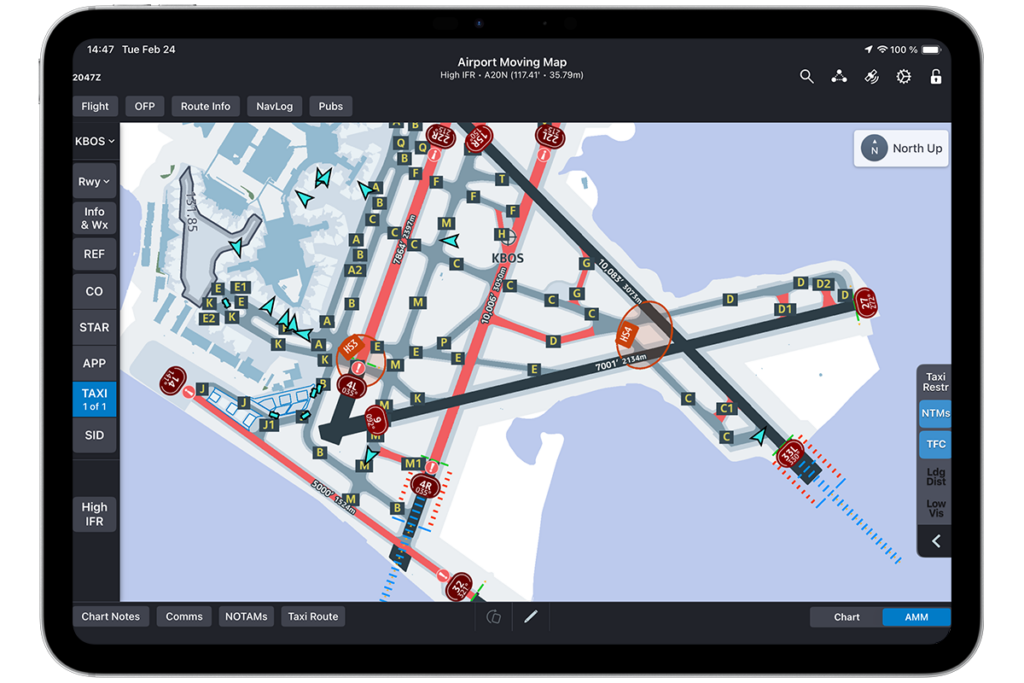
Navigating large or unfamiliar airports can be challenging, particularly during complex taxi operations or in low-visibility conditions. An EFB equipped with contextual airport information significantly enhances situational awareness in these scenarios.
Jeppesen’s Integrated EFB offers several innovations through its Smart Airport Maps solution, such as Graphical NOTAMs, Taxi Times, and Airport Traffic features.
Enable pilots to:
Achieve better situational awareness
Reduce cognitive load
Shorten taxi times
Reduce taxiway fuel burn
Execute safer ground movements
With improved surface-level visibility and decision-making, Smart Airport Maps elevates navigational accuracy, safety and efficiency.
Long taxi times depicted at Boston Logan Airport during a winter storm on Smart Airport Maps in FliteDeck Pro.
Fuel conservation extends beyond airborne operations. Effective ground strategies—like Reduced-Engine Taxi Procedures—enable further savings while preserving engine life.
An EFB with Jeppesen Smart Airport Maps provides pilots with accurate data for airport surface navigation, making reduced engine procedures not just viable but highly effective. Jeppesen’s Taxi Times feature equips pilots with historical and real-time ADS-B data, helping them decide when and how to implement fuel-saving taxi strategies.
Why it matters:
Reduce fuel consumption during taxiing while shortening taxi times
Boost overall fleet sustainability through optimized ground movements
Improve pilot positional and situational awareness and safe ground movements
These advanced tools aid pilots in their contribution toward reduced fuel-burn and environmental goals.
Modernize pilot workflows with Jeppesen ForeFlight
Adopting an integrated EFB ecosystem offers pilots a host of solutions to simplify workflows, enhance decision-making and reduce costs. By consolidating multi-app functionalities into a pilots EFB, airlines benefit from operational efficiency, data-driven insights and improved pilot performance on every flight. Meanwhile, pilots can centralize operations into a single, integrated application.
From digitized flight briefings and navigation logging to fuel optimization and enhanced situational awareness, the benefits of an integrated EFB ecosystem go far beyond the cockpit to empower pilots, dispatchers and operations teams to achieve better outcomes for their airlines—and the environment.