

Put Dispatcher Time on the Flights That Pay Off
How ranking every flight by recoverable value turns a busy board into a shift-by-shift priority list.
Picture the last hour of a busy evening bank. Seventy departures still to release, three already running late, and a dispatcher is staring at a reroute, trying to decide whether it’s worth the ten minutes it would take to rebuild the plan. The call has to be made in about forty seconds before the next release lands.
Multiply that decision across every flight on the board, and the question underneath the releases and phone calls is: which of these flights still holds savings worth going after right now?
Most don’t. On any given shift, the majority of filed plans fly close to optimal untouched. The real savings sit in a small number of flights, and those flights shift as the day unfolds. They look no different from the rest of the board — nothing marks them as the ones worth reviewing.
The flights worth reviewing don’t look any different
It has nothing to do with a team being too slow or missing something obvious; a plan worth reworking and a plan that’s optimal look identical on the board until someone runs the math, and the math takes time.
On a quiet afternoon, an experienced dispatcher goes hunting and finds savings through better routing. On a busy evening, that same dispatcher is heads-down keeping releases moving, and the savings that were there at 5 PM are wheels-up by 7 PM. The value didn’t disappear, there was just no minute to find it.
The flight planning system is doing exactly its job, building strong, compliant plans quickly. But its work is essentially done the moment a plan is filed. Deciding which of a hundred filed plans is still worth revisiting, and in what order, is a different question entirely.
Put the savings at the top of the list
Jeppesen Dispatch Analytics sits alongside whatever planning system is already in place and does the one thing that system was never meant to do: it keeps score. It looks across the whole schedule, works out how much each flight could still save if it were re-optimized, and ranks them, with the most recoverable value at the top, based on the metric that matters most for that flight.
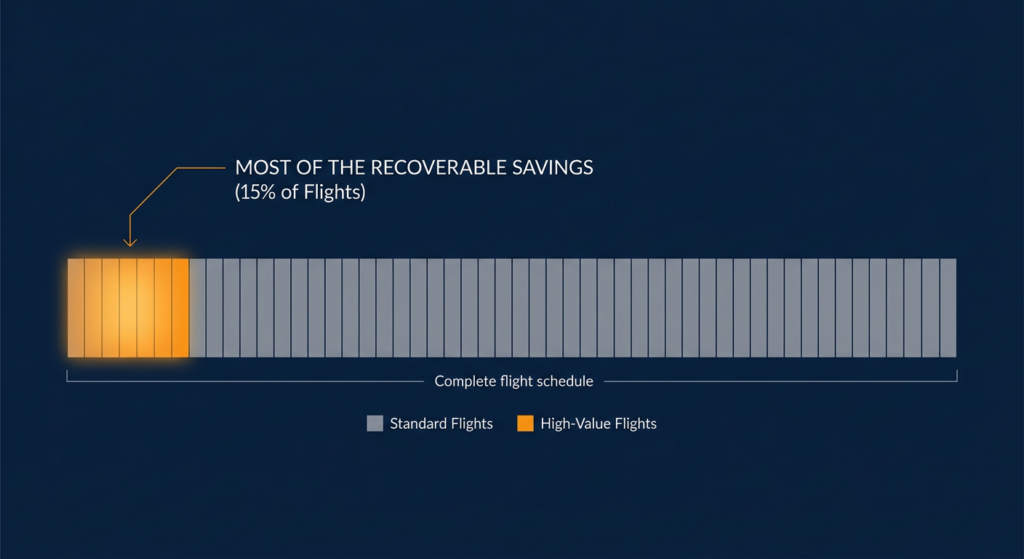
For the dispatcher, the board stops being a flat list and becomes a ranked one. The flight that’s worth ten minutes sits right at the top, with a better plan already computed and waiting beside the one that was filed. The sixty flights that are perfectly fine settle to the bottom.
What counts as most valuable is set by the operation, not fixed by the tool, and it doesn’t hold still. A flight worth optimizing for fuel at midday can matter more for delay exposure or schedule recovery by the evening bank, as conditions around it change. Point the ranking at what the moment calls for, and the flights that rise to the top move with it.
The same team, a bigger operation
The reason this matters beyond a single shift is headcount. A growing schedule usually means the choice between adding dispatchers or quietly letting optimization slip. A ranked board changes that math. As the operation grows, the list grows with it, but the top still shows the handful of flights carrying most of the value. The team covers more without working more, because effort follows value instead of volume.
See your own board, ranked
The quickest way to see it is to sort a live schedule by opportunity and notice how few flights are really carrying the load on a given night.
Read the brochure to see how the board learns to sort itself, then find out what a ranked shift would surface across your own operation.
How ranking every flight by recoverable value turns a busy board into a shift-by-shift priority list.
Picture the last hour of a busy evening bank. Seventy departures still to release, three already running late, and a dispatcher is staring at a reroute, trying to decide whether it’s worth the ten minutes it would take to rebuild the plan. The call has to be made in about forty seconds before the next release lands.
Multiply that decision across every flight on the board, and the question underneath the releases and phone calls is: which of these flights still holds savings worth going after right now?
Most don’t. On any given shift, the majority of filed plans fly close to optimal untouched. The real savings sit in a small number of flights, and those flights shift as the day unfolds. They look no different from the rest of the board — nothing marks them as the ones worth reviewing.
The flights worth reviewing don’t look any different
It has nothing to do with a team being too slow or missing something obvious; a plan worth reworking and a plan that’s optimal look identical on the board until someone runs the math, and the math takes time.
On a quiet afternoon, an experienced dispatcher goes hunting and finds savings through better routing. On a busy evening, that same dispatcher is heads-down keeping releases moving, and the savings that were there at 5 PM are wheels-up by 7 PM. The value didn’t disappear, there was just no minute to find it.
The flight planning system is doing exactly its job, building strong, compliant plans quickly. But its work is essentially done the moment a plan is filed. Deciding which of a hundred filed plans is still worth revisiting, and in what order, is a different question entirely.
Put the savings at the top of the list
Jeppesen Dispatch Analytics sits alongside whatever planning system is already in place and does the one thing that system was never meant to do: it keeps score. It looks across the whole schedule, works out how much each flight could still save if it were re-optimized, and ranks them, with the most recoverable value at the top, based on the metric that matters most for that flight.
For the dispatcher, the board stops being a flat list and becomes a ranked one. The flight that’s worth ten minutes sits right at the top, with a better plan already computed and waiting beside the one that was filed. The sixty flights that are perfectly fine settle to the bottom.
What counts as most valuable is set by the operation, not fixed by the tool, and it doesn’t hold still. A flight worth optimizing for fuel at midday can matter more for delay exposure or schedule recovery by the evening bank, as conditions around it change. Point the ranking at what the moment calls for, and the flights that rise to the top move with it.
The same team, a bigger operation
The reason this matters beyond a single shift is headcount. A growing schedule usually means the choice between adding dispatchers or quietly letting optimization slip. A ranked board changes that math. As the operation grows, the list grows with it, but the top still shows the handful of flights carrying most of the value. The team covers more without working more, because effort follows value instead of volume.
See your own board, ranked
The quickest way to see it is to sort a live schedule by opportunity and notice how few flights are really carrying the load on a given night.
Read the brochure to see how the board learns to sort itself, then find out what a ranked shift would surface across your own operation.