

Recover the Savings Your Filed Flight Plans Leave Behind
An optimization layer that continuously re-evaluates filed flight plans as conditions change, surfacing better alternatives before departure.
Every airline knows a good flight plan saves money. What’s easy to forget is that a filed plan is only optimal for the moment it was filed. Conditions keep changing after that: winds shift, airspace opens and closes, flow restrictions appear, and a routing that looked expensive at filing time suddenly isn’t. By pushback, the plan built three hours earlier may no longer be the best option available.
Across a full day of flying, that gap adds up on the P&L. Not every flight is affected equally. Some plans are already close to optimal. Others still hold recoverable value: fuel, avoidable delay, lower enroute charges, protected arrival times. The savings are there; the hard part is finding them across hundreds of flights, every shift, in time to act.
That’s the gap Jeppesen Dispatch Analytics closes, and the reason it shows up directly in operating costs.
Why strong flight plans still leave value behind
Modern flight planning systems are good at their job. They produce compliant, operationally sound plans quickly and reliably. But a flight planning system is built to answer one question well: what’s a strong plan for this flight, right now? It isn’t built to keep re-asking that question for every flight in the schedule as departure approaches and conditions shift underneath it.
Most operations fall back on a few imperfect habits. Some lean on dispatcher judgment, trusting experienced staff to spot rerouting opportunities in a spare minute. This is inconsistent, and it doesn’t scale once the board fills up. Some treat the filed plan as final, so any savings that emerge later go unclaimed. Some weigh replacing the flight planning system outright, a heavy investment in time, cost, and risk that only addresses how plans are created, not how they’re improved after filing.
None of that solves the actual problem: monitoring the entire schedule continuously, identifying which flights still hold recoverable value, and surfacing a better option while there’s time to act on it.
How continuous 4D optimization works
Jeppesen Dispatch Analytics runs alongside the flight planning system already in place, as an advanced optimization layer. It doesn’t replace the plans your current dispatch team knows and trusts — it re-examines them continuously and computes a better alternative whenever one appears.
The “4D” is where the value comes from. For each flight, the engine evaluates:
- Lateral route: the path across the ground
- Vertical profile: the altitudes flown
- Speed: how the flight is flown along that path
- Time: how those three interact with conditions and constraints as they evolve
It weighs those together against the metrics that matter operationally: fuel burn, flight time, ATC delay exposure, enroute charges, and the priority set for that mission. Because these trade-offs are rarely linear, the best answer usually isn’t the same route flown a little faster or slower, it’s often a genuinely different trajectory, the kind a single static plan calculation would never surface.
The trade-offs aren’t the whole story. The objective they serve changes flight to flight. A schedule-critical departure protecting a downstream connection is a different problem than an off-peak sector optimizing for total cost, which is different again from a flight threading congested airspace where avoiding delay decides the routing. The best target for one flight is earliest arrival; for another it’s minimum fuel, lowest total cost, least delay exposure, or the Cost Index trade-off suited to that mission. Dispatch Analytics optimizes each flight against the objective that applies to it, not a single company-wide setting, turning it from a rerouting tool into a decision-support layer that assesses the whole schedule against the right goal for each departure and surfaces the subset of flights where real upside remains.
One month, measured
The best argument for continuous optimization isn’t a projection, it’s measured potential, quantified against real filed plans. Over a single month in May 2024, Jeppesen Dispatch Analytics analyzed the operation of a major European low-cost carrier and measured the savings opportunity relative to that carrier’s own filed flight plans:
2.19%
less fuel burned identified (est. €143,300)
3.25%
lower enroute charges identified (est. €916,000)
30,971
avoidable delay minutes identified (est. €412,000)
€173,500
total savings identified in one month, on a conservative like-for-like comparison
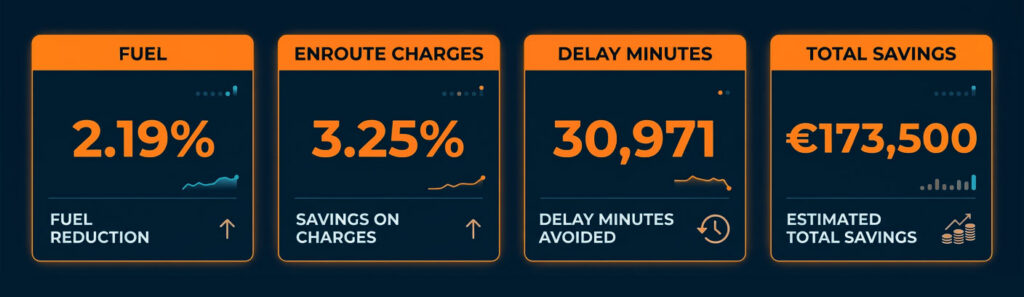
The gap between those two numbers is worth noting. Across the full flight set, total improvement potential topped €1.4 million for the month. The €173,500 figure is the more conservative one: savings identified on matched, like-for-like routes against the carrier’s own filed plans, using real ATC data from Eurocontrol’s B2B feed, a defensible number for a budget review, not a best-case simulation.
The same analysis found average flight time could be reduced by about 0.9 percent. On a full network, that’s not a rounding error, it works out to roughly 1.5 additional aircraft-equivalents of productive capacity recoverable without adding a single tail to the fleet.
Savings that don’t depend on luck
The real value isn’t any one clever reroute. It’s removing the dependence on luck. A strong dispatcher might catch a great alternative on a quiet afternoon, but that same opportunity, buried in a board of hundreds of flights on a busy evening, slips by. Dispatch Analytics removes that variability — it scans the whole schedule every time and surfaces the highest-value opportunities first, ranked by whatever metric matters most that day.
The result is fuel savings recovered across the network instead of here and there, fewer delay minutes and less exposure to the ATC slot penalties that hurt most, and lower enroute charges wherever a cheaper routing exists. Depending on the network and how the day is running, that’s an extra 1–2 percent of savings on top of an already strong planning baseline, a figure that compounds month after month.
See what your own schedule is leaving behind
The savings in that European carrier’s numbers weren’t invented; they were already sitting in the schedule, waiting to be found. The same is almost certainly true of most operations. The only real question is whether they can be found consistently and acted on in time.
Here’s how to go deeper:
- Learn more about Jeppesen Dispatch Analytics.
- Talk to our team about a route- and network-level analysis of your own operation.
Contact us to find out how much value your schedule is still holding.
An optimization layer that continuously re-evaluates filed flight plans as conditions change, surfacing better alternatives before departure.
Every airline knows a good flight plan saves money. What’s easy to forget is that a filed plan is only optimal for the moment it was filed. Conditions keep changing after that: winds shift, airspace opens and closes, flow restrictions appear, and a routing that looked expensive at filing time suddenly isn’t. By pushback, the plan built three hours earlier may no longer be the best option available.
Across a full day of flying, that gap adds up on the P&L. Not every flight is affected equally. Some plans are already close to optimal. Others still hold recoverable value: fuel, avoidable delay, lower enroute charges, protected arrival times. The savings are there; the hard part is finding them across hundreds of flights, every shift, in time to act.
That’s the gap Jeppesen Dispatch Analytics closes, and the reason it shows up directly in operating costs.
Why strong flight plans still leave value behind
Modern flight planning systems are good at their job. They produce compliant, operationally sound plans quickly and reliably. But a flight planning system is built to answer one question well: what’s a strong plan for this flight, right now? It isn’t built to keep re-asking that question for every flight in the schedule as departure approaches and conditions shift underneath it.
Most operations fall back on a few imperfect habits. Some lean on dispatcher judgment, trusting experienced staff to spot rerouting opportunities in a spare minute. This is inconsistent, and it doesn’t scale once the board fills up. Some treat the filed plan as final, so any savings that emerge later go unclaimed. Some weigh replacing the flight planning system outright, a heavy investment in time, cost, and risk that only addresses how plans are created, not how they’re improved after filing.
None of that solves the actual problem: monitoring the entire schedule continuously, identifying which flights still hold recoverable value, and surfacing a better option while there’s time to act on it.
How continuous 4D optimization works
Jeppesen Dispatch Analytics runs alongside the flight planning system already in place, as an advanced optimization layer. It doesn’t replace the plans your current dispatch team knows and trusts — it re-examines them continuously and computes a better alternative whenever one appears.
The “4D” is where the value comes from. For each flight, the engine evaluates:
- Lateral route: the path across the ground
- Vertical profile: the altitudes flown
- Speed: how the flight is flown along that path
- Time: how those three interact with conditions and constraints as they evolve
It weighs those together against the metrics that matter operationally: fuel burn, flight time, ATC delay exposure, enroute charges, and the priority set for that mission. Because these trade-offs are rarely linear, the best answer usually isn’t the same route flown a little faster or slower, it’s often a genuinely different trajectory, the kind a single static plan calculation would never surface.
The trade-offs aren’t the whole story. The objective they serve changes flight to flight. A schedule-critical departure protecting a downstream connection is a different problem than an off-peak sector optimizing for total cost, which is different again from a flight threading congested airspace where avoiding delay decides the routing. The best target for one flight is earliest arrival; for another it’s minimum fuel, lowest total cost, least delay exposure, or the Cost Index trade-off suited to that mission. Dispatch Analytics optimizes each flight against the objective that applies to it, not a single company-wide setting, turning it from a rerouting tool into a decision-support layer that assesses the whole schedule against the right goal for each departure and surfaces the subset of flights where real upside remains.
One month, measured
The best argument for continuous optimization isn’t a projection, it’s measured potential, quantified against real filed plans. Over a single month in May 2024, Jeppesen Dispatch Analytics analyzed the operation of a major European low-cost carrier and measured the savings opportunity relative to that carrier’s own filed flight plans:
| 2.19% | less fuel burned identified (est. €143,300) |
| 3.25% | lower enroute charges identified (est. €916,000) |
| 30,971 | avoidable delay minutes identified (est. €412,000) |
| €173,500 | total savings identified in one month, on a conservative like-for-like comparison |
The gap between those two numbers is worth noting. Across the full flight set, total improvement potential topped €1.4 million for the month. The €173,500 figure is the more conservative one: savings identified on matched, like-for-like routes against the carrier’s own filed plans, using real ATC data from Eurocontrol’s B2B feed, a defensible number for a budget review, not a best-case simulation.
The same analysis found average flight time could be reduced by about 0.9 percent. On a full network, that’s not a rounding error, it works out to roughly 1.5 additional aircraft-equivalents of productive capacity recoverable without adding a single tail to the fleet.
Savings that don’t depend on luck
The real value isn’t any one clever reroute. It’s removing the dependence on luck. A strong dispatcher might catch a great alternative on a quiet afternoon, but that same opportunity, buried in a board of hundreds of flights on a busy evening, slips by. Dispatch Analytics removes that variability — it scans the whole schedule every time and surfaces the highest-value opportunities first, ranked by whatever metric matters most that day.
The result is fuel savings recovered across the network instead of here and there, fewer delay minutes and less exposure to the ATC slot penalties that hurt most, and lower enroute charges wherever a cheaper routing exists. Depending on the network and how the day is running, that’s an extra 1–2 percent of savings on top of an already strong planning baseline, a figure that compounds month after month.
See what your own schedule is leaving behind
The savings in that European carrier’s numbers weren’t invented; they were already sitting in the schedule, waiting to be found. The same is almost certainly true of most operations. The only real question is whether they can be found consistently and acted on in time.
Here’s how to go deeper:
- Learn more about Jeppesen Dispatch Analytics.
- Talk to our team about a route- and network-level analysis of your own operation.
Contact us to find out how much value your schedule is still holding.