Jeppesen On-Demand Tailoring vs Tailored Maps: Which Fits Your Operation?
Quick answer: On-Demand Tailoring is Jeppesen Ground Controls‘ most comprehensive content customization option, combining Tailored Maps and Customer-Inserted Charts (CIC) in one solution. Tailored Maps supplements Jeppesen FliteDeck Pro‘s enroute map with company-specific navigational data, while On-Demand Tailoring extends those capabilities with chart insertion and publishing for PDF charts and other content delivered directly to pilot EFBs in real-time. Customers can also choose Tailored Maps or CIC separately as standalone add-ons, depending on operational needs.
Airline operations depend on accurate, timely aeronautical data reaching pilots at the precise moment they need it. Yet the traditional 28-day AIRAC revision cycle often leaves a gap between when company information changes and when flight crews can actually see it. Jeppesen Ground Controls addresses this challenge with flexible content customization options, led by On-Demand Tailoring, which combines Tailored Maps and CIC in a single workflow. For operators with more specific needs, Tailored Maps and CIC can also be deployed as standalone add-ons.
Understanding the difference between these modules matters because the right choice affects operational efficiency, distribution costs, and how quickly your back office can respond to changing conditions. This guide explains how On-Demand Tailoring fits as the broadest option, where Tailored Maps fits within that framework, and how to determine whether your operation needs the full combined capability or a standalone add-on.
If you’re new to the broader platform, our previous post—”What is Jeppesen Ground Controls?“—provides helpful context on the full suite.
What are Tailored Maps?
Tailored Maps is a module inJeppesen Ground Controls that allows operators to supplement FliteDeck Pro’s data-driven enroute map with company-specific, in-house content. Rather than replacing standard navigational data, the module layers proprietary operational information directly onto the maps pilots already use.
Content administrators can create, revise, and publish a wide range of company-specific enroute data, including:
Decompression and terrain escape procedures and enroute diversion routes
Fleets
ETOPS range rings and distances from shoreline
Authorized airports and usage
Fleet and company communications, notes, and contacts
Company-specific waypoints, boundaries, and special use airspace
Grid MORAs
Location-based communications
Custom boundaries
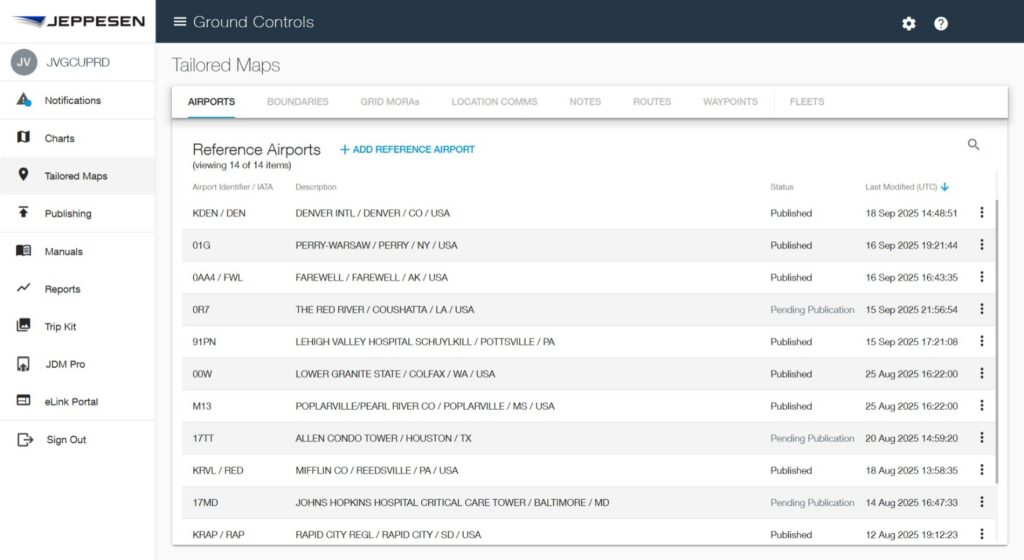
Tailored Maps Tab in Ground Controls
What are the benefits of Tailored Maps?
The defining benefit of Tailored Maps is independence from the 28-day revision cycle. You can publish date-specific or real-time updates on your own schedule, ensuring that company-specific information reaches pilots in minutes rather than weeks.
Other benefits include:
Lower operational costs through on-demand self-service data management and distribution
Reduced heads-down time, since pilots never have to leave FliteDeck Pro to view updates
Shared situational awareness, because ground and flight crews access the same data simultaneously
Fewer operational disruptions caused by missing or delayed company-specific data
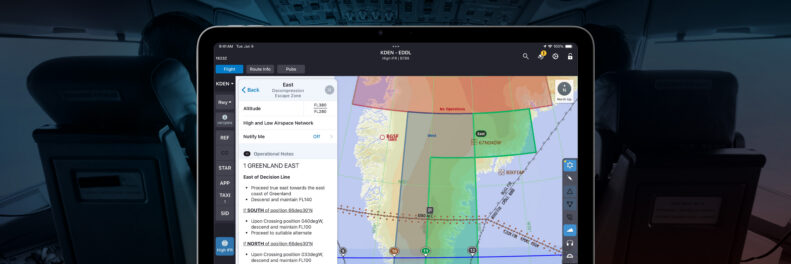
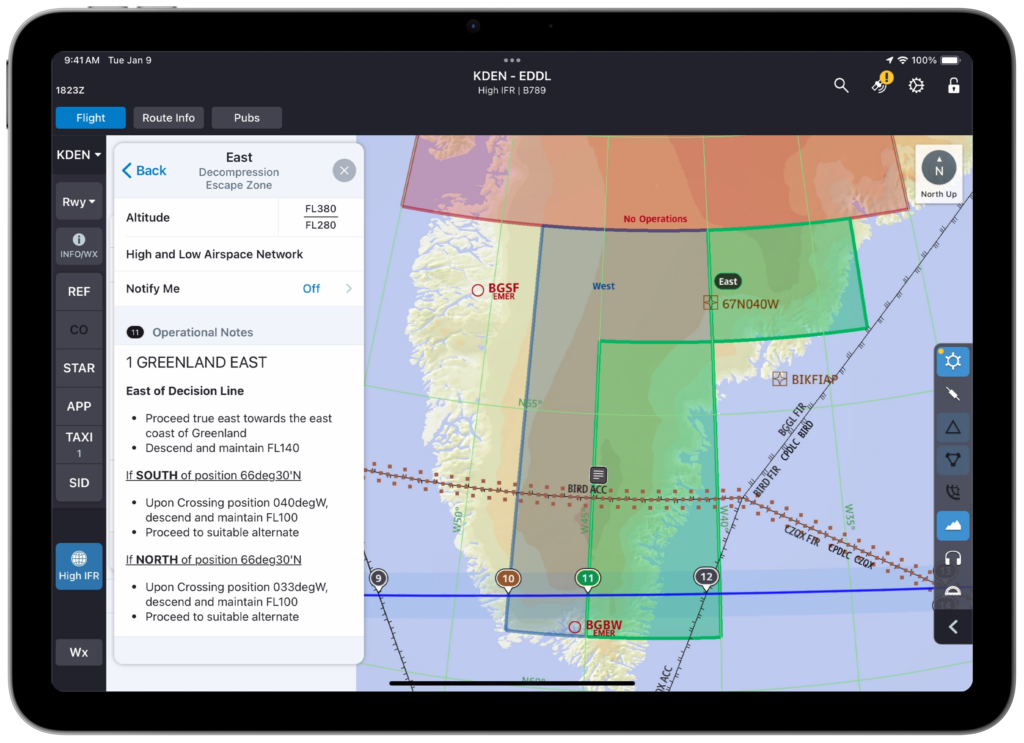
Custom Inserted Decompression and Escape Zones over Greenland
Where are Tailored Maps used?
Tailored Maps suits commercial airlines that need to overlay proprietary operational data onto standard charts. Common applications include managing ETOPS range rings across long-haul fleets, communicating frequently changing airport authorization statuses, and distributing company waypoints and diversion procedures across an entire operation.
Tailored Maps covers a substantial range of navigational content as a standalone add-on. Airlines that also need to distribute full charts—such as company-specific approach plates or taxi diagrams in PDF form—or want a combined workflow for map customization plus CIC should look to On-Demand Tailoring.
What is On-Demand Tailoring?
On-Demand Tailoring is a more comprehensive Jeppesen Ground Controls add-on that combines two of the platform’s most popular capabilities: Tailored Maps and CIC In addition to supplementing FliteDeck Pro’s enroute map with company-specific information, On-Demand Tailoring enables operators to publish company charts and other content directly to pilot EFBs in real-time.
The module’s distinguishing feature is chart insertion. Operations can convert PDF charts and multi-page files into a format viewable in both day and night mode on FliteDeck Pro, then publish that content independent of established cycles—either on-demand or for specific dates.
What are the benefits of On-Demand Tailoring?
On-Demand Tailoring inherits every capability available in Tailored Maps and extends it with chart management functionality. As the broadest Ground Controls content-customization option, its key benefits include:
Improved flight crew efficiency, with all company content available in one place on FliteDeck Pro
Increased operational flexibility, since content can be created and distributed independent of AIRAC cycles
Greater information security, because customized content is created and distributed in-house without a third-party provider
Quality assurance, through side-by-side comparison of original PDF files against inserted content before publishing
Centralized control, using the Ground Controls app content publishing history
You can publish CICs to FliteDeck Pro, Trip Kit, and Chart Viewer simultaneously, and placed into specific regional coverages or categories—such as Approach or Taxi—in alignment with FliteDeck Pro’s structure. In summary, On-Demand Tailoring suits operations that need CICs alongside tailored data (maps).
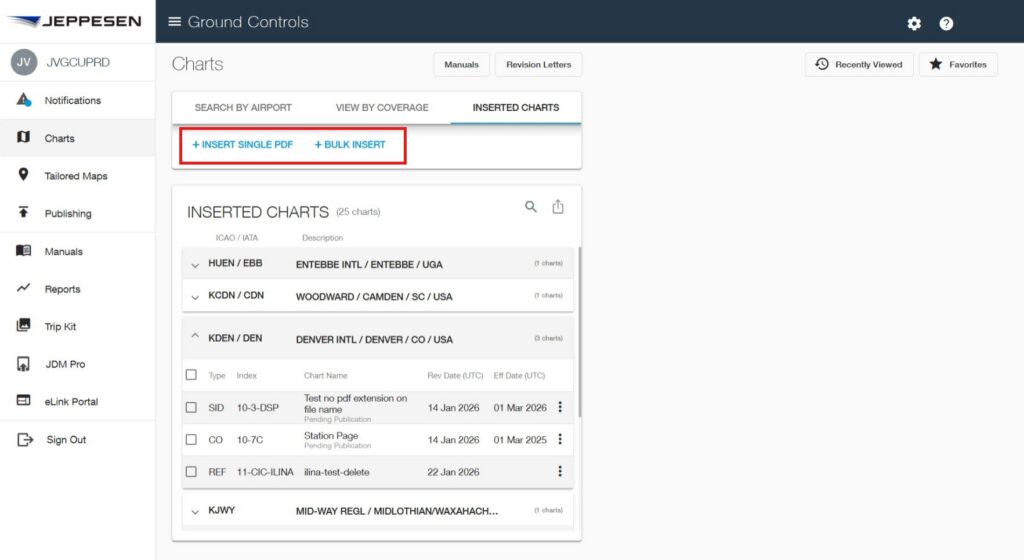
Inserted Charts Tab in Ground Controls
Where is On-Demand Tailoring used?
On-Demand Tailoring benefits operations that must distribute both tailored data content and CICs directly to crews. Examples include publishing company-specific Approach or Taxi charts, inserting Airport Briefing charts on demand, and maintaining a secure, in-house content distribution workflow for operations that prefer to avoid third-party involvement.
What are the key differences between Tailored Maps and On-Demand Tailoring?
The two options share a common foundation, but they differ in scope. On-Demand Tailoring is the broader offering because it includes Tailored Maps and CIC, while Tailored Maps remains available separately for operators that only need map-based customization. The table below summarizes the core distinctions.
Capability
Tailored Maps
On-Demand Tailoring
Enroute map customization
Yes
Yes
Company-specific data overlays
Yes
Yes
Independent of AIRAC cycles
Yes
Yes
PDF chart conversion and insertion
No
Yes
Insert content into Trip Kit and Chart Viewer simultaneously
No
Yes
Side-by-side PDF comparison before publishing
No
Yes
Best suited for
Map supplementation
Map supplementation plus CIC-based chart distribution
In short, every Tailored Maps capability is included within On-Demand Tailoring. The deciding factor is whether your operation needs the full combined solution—including CIC—or a standalone add-on focused only on Tailored Maps or CIC.
How do you choose the right approach?
The decision depends on whether your operation needs a combined content-customization workflow or a more targeted standalone add-on.
Choose Tailored Maps if your primary requirement is supplementing FliteDeck Pro’s enroute and airport maps with company-specific navigational data—such as ETOPS range rings, authorized airports, custom boundaries, and diversion procedures—and you do not need to distribute CICs.
Choose On-Demand Tailoring if your operation needs the broadest option: Tailored Maps plus CIC in one workflow, including the ability to convert, verify, and publish CICs directly to pilot EFBs, Trip Kit, and Chart Viewer.
Throughout either decision, safety and regulatory compliance remain paramount. Both modules support safe flight operations by ensuring pilots see important, company-specific information without leaving their EFB application, and both maintain publishing history for accountability and traceability.
How does Jeppesen ForeFlight support both approaches?
Jeppesen ForeFlight strengthens both customization strategies through robust charting and data management on one side, and dynamic, real-time information on the other.
For operations leaning toward a tailored approach, Jeppesen ForeFlight delivers comprehensive charting and structured data management that keeps curated, mission-specific information organized and reliable. This supports the same principle behind Tailored Maps: putting the right navigational content in the right place, ready when crews need it.
For operations requiring greater flexibility, Jeppesen ForeFlight provides real-time weather, interactive maps, and dynamic route adjustments that mirror the on-demand philosophy. These features allow pilots and dispatchers to respond to changing conditions immediately, ensuring decisions are made on current information rather than data fixed to a 28-day revision cycle.
By supporting both static reliability and real-time adaptability, Jeppesen ForeFlight serves a wide spectrum of operational profiles within a single, intuitive platform. To see how Jeppesen ForeFlight’s charting, data management, and real-time planning features can support your flight operations, explore the platform and request a demonstration today.
Frequently asked questions
What is the main difference between Tailored Maps and On-Demand Tailoring? Tailored Maps customizes FliteDeck Pro’s enroute and airport maps with company-specific data. On-Demand Tailoring includes all Tailored Maps capabilities and adds chart insertion, allowing operators to convert PDF charts and publish them directly to pilot EFBs in real-time.
Can both modules publish content outside the 28-day AIRAC cycle? Yes. Both Tailored Maps and On-Demand Tailoring allow content to be created, published, and distributed independent of established revision cycles, either on-demand or for specific dates.
Does On-Demand Tailoring replace Tailored Maps? No. On-Demand Tailoring incorporates every Tailored Maps capability and extends it with chart insertion functionality. Operations that only need enroute map supplementation may find Tailored Maps sufficient on its own.
Which module is better for distributing company approach or taxi charts? On-Demand Tailoring is the appropriate choice, because it can convert PDF charts and multi-page files into a FliteDeck Pro-compatible format and insert them into specific categories such as Approach or Taxi.
How do these modules improve flight safety? Both modules ensure pilots see important, company-specific information without leaving their EFB application, reducing heads-down time and improving situational awareness across ground and flight operations.