From Tail Assignment to the Flight Deck: Three Ways Jeppesen ForeFlight Saves You Fuel on Every Flight
At Jeppesen ForeFlight, we help airlines reduce fuel costs by up to 2% at every stage of their operation, often using tools already in the hands of their crews. Here’s how we do it:
Fleet Planning: Put the right tail on the right route and save 0.5-1% with Jeppesen Tail Assignment. That’s potentially $84,000 per tail.
Flight Planning: Optimize the routes you fly and save 0.5-1% with Jeppesen Dispatch.
Flight Deck: Optimize both climb and cruise and save up to 2% with Cost Index Optimizer in Jeppesen FliteDeck Pro-likely already used by your pilots.
Fuel costs escalated into a crisis in 2026 following the Strait of Hormuz closure and peaking in March at $195 per barrel. S&P Global Market Intelligence raised full-year fuel expense forecasts by 9%, while global supply issues pushed costs even higher. Even when this latest crisis passes, fuel is still the largest variable cost for any airline and could trigger another crisis.
In response to the crisis, many airlines are raising fares 5-9% to offset costs. Imagine what a competitive advantage it would be to secure 1.5-2% in fuel savings. Let’s explore these three solutions further.
1. Get the Right Tail on the Right Route with Smart Tail Assignment
Fuel savings start long before an aircraft leaves the gate. It begins at the scheduling desk. Here, planners make critical decisions about which aircraft flies which route.
Many assume that two aircraft of the same model perform identically, but each has unique fuel efficiency characteristics. Even within the same fleet, there can be up to a 6% variation in fuel burn between identical airframes. This is due to differences in engine wear, aerodynamic degradation, age, and maintenance history.
Jeppesen Tail Assignment moves beyond routine maintenance into strategic fuel-based routing, deploying the most efficient engines on the longest, highest-cost sectors. By strategically assigning less efficient aircraft to lower-cost routes or outstations, airlines save on fuel and operating costs.
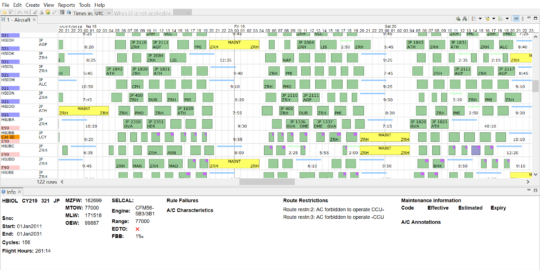
Jeppesen Tail Assignment solves the challenge of the 6% fuel burn variation by automatically pairing the most efficient airframes with the most demanding routes. By replacing manual processes with a multi-objective optimization engine, airlines can maximize savings where they matter most. The result is up to 1% in annual fuel savings— $84,000 per aircraft—achieved through constant automation involving dozens or even hundreds of variables, far more than any human could do on their own.
Use advanced modeling and scenario capabilities to ensure the right tail is assigned to the right route.
2. Optimize Your Routes with Jeppesen Dispatch Analytics
Planners assign the right aircraft, but dispatch teams need accurate data for efficient flight plans. Jeppesen Dispatch integrated analytics saves fuel by analyzing the routes you’ve actually flown (or even those of competitors), and comparing them with optimized alternatives, thus identifying smarter ways to save fuel, reduce delays, and cut costs.
“With Jeppesen Dispatch engine route, we can see that we can gain more benefits with fuels savings, time savings, and also total cost savings. So it’s very good for us.” Emre Güney, Assistant OCC Manager, Corendon Airlines Read the full Corendon Airlines case study
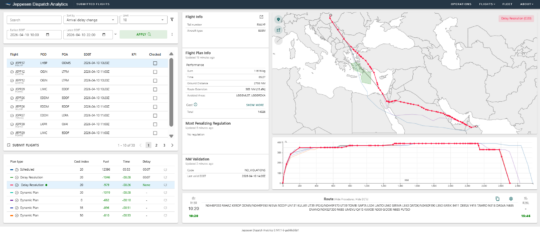
Dispatch Analytics factors in real-world variables like route restrictions and airspace costs. By calculating overflight fees and fuel burn, it provides ground teams with a clear, actionable map to savings.
In this example, Jeppesen Dispatch Analytics compares the route flown with an optimized alternative, creating a literal map to savings.
3. Optimize Climb and Cruise with Cost Index Optimization
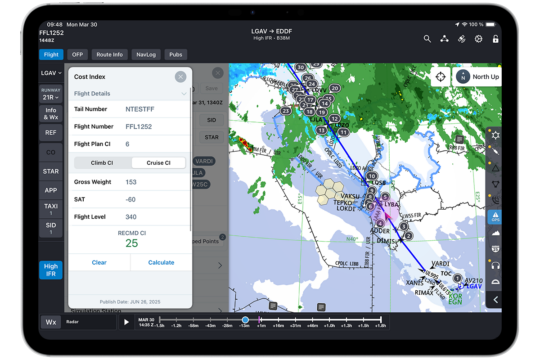
While dispatch sets the plan, the flight deck manages the reality. Integrated directly into FliteDeck Pro, Jeppesen Cost Index Optimization provides performance recommendations that reduce climb and cruise fuel burn by up to 2%. Cost Index Optimization doesn’t just optimize climb or cruise fuel burn like so many standalone tools – it’s built into the EFB your crews already use within FliteDeck Pro. Fuel efficiency apps don’t help if they aren’t used by your crews. Because app fatigue on the flight deck is very real, adoption is more likely when integrated into our industry-leading EFB.
And when it comes to that optimization, instead of relying on static book numbers, pilots enter weight, temperature, and altitude to generate a tail-specific cost index for entry into the Flight Management Computer. For AID-equipped aircraft, the Cost Index Optimizer can automate this process. As weather or ATC reroutes occur, new automated recalculation prompts allow crews to adjust these calculations dynamically, capturing up to 2% in fuel savings that traditional FMS platforms leave behind.
Unlike traditional flight management systems, Cost Index Optimization dynamically adjusts to changing conditions, providing precise recommendations for every flight segment. Airlines have reported significant fuel and CO₂ savings, with some achieving up to 1.7% within months. Its integration into FliteDeck Pro ensures quick adoption and a fast return on investment, without requiring additional hardware or training.
For short-haul and regional flights, where the climb phase accounts for a large share of fuel use, tailored guidance guarantees measurable savings, even with shorter cruise times. By equipping pilots with precise data, your airline reduces fuel burn, cuts costs, and advances sustainability goals.
Take the First Step Toward Smarter Fuel Savings
Achieving meaningful fuel reductions requires a unified approach. Jeppesen ForeFlight is the only partner offering data-driven solutions that deliver measurable fuel savings in every phase of flight. From scheduling to the flight deck, airlines can reduce costs, enhance efficiency, and drive sustainability. Start optimizing your flight operations today.